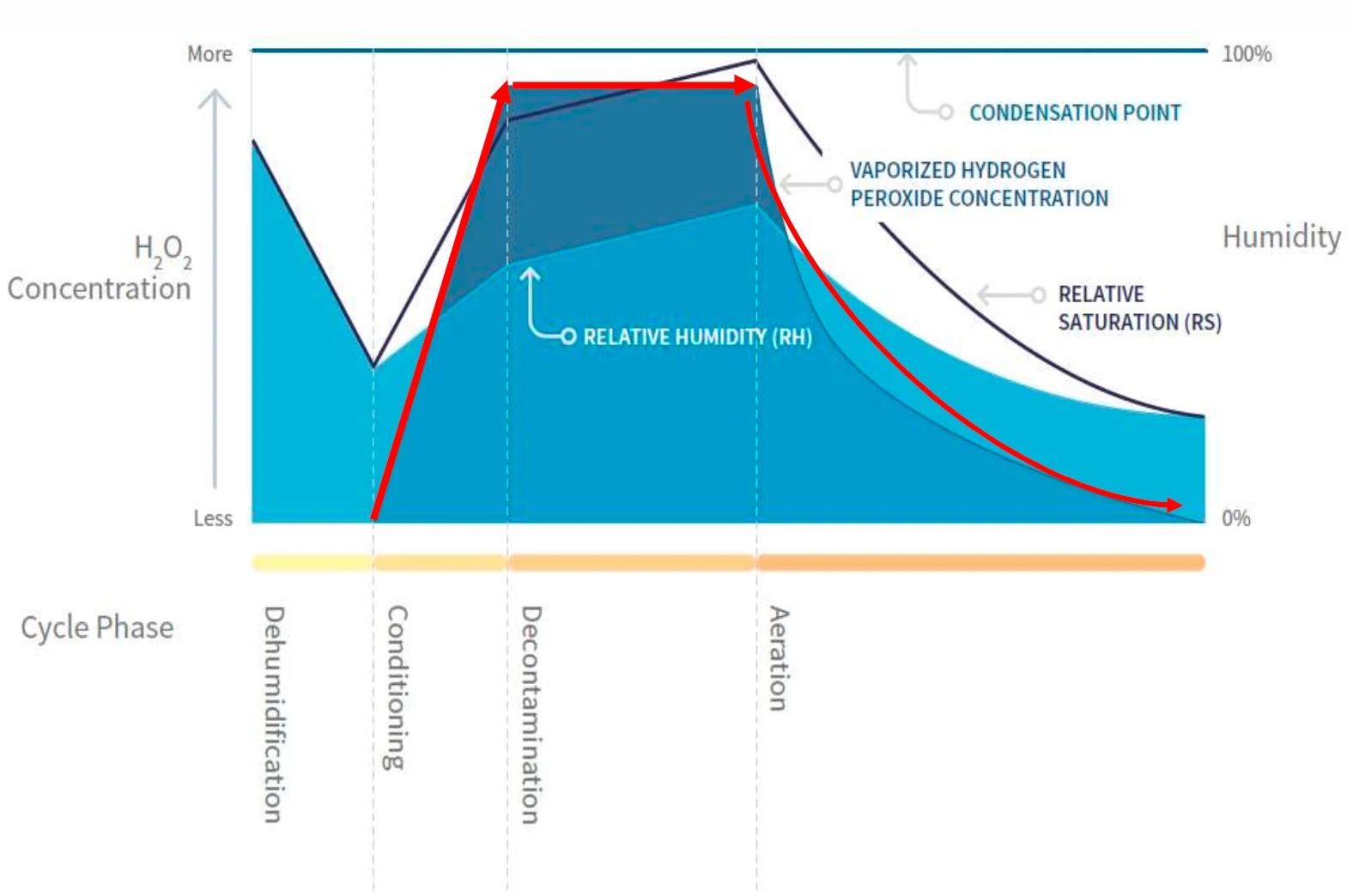
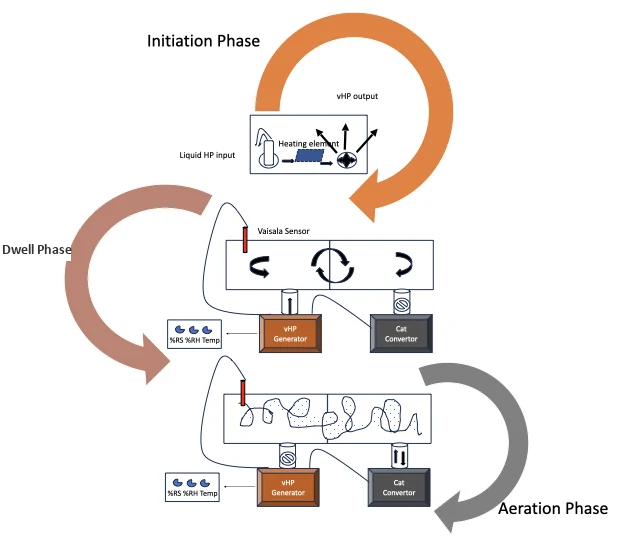
The DECX cycle runs three phases — Initiation, Dwell, and catalytic Aeration — with no dehumidification pre-conditioning step. That single removal is what cuts total cycle time and lets facilities run more batches per shift than legacy fumigation methods.
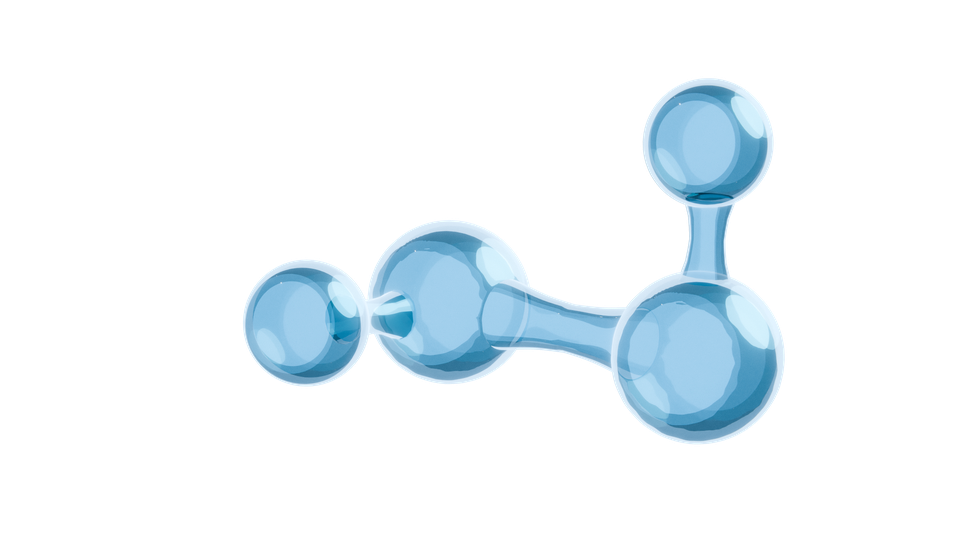
H₂O₂ (35–50% Food grade) vaporised 0.25nm molecules generated. Vaisala sensors continuously monitor RS% relative saturation — system prevents saturation, no condensation risk.
- Vaporation — not large 10µm aerosol droplets
- RS% monitored in real time
- Any Food grade 35-50% H₂O₂ supplier
Generator maintains Vapour ppm concentration and dwell time while preventing saturation and condensation. 6-log₁₀ kill occurs across all surfaces including hidden cavities. Vapour not affected by gravitational pull.
- Relative Saturation RS% control without condensation
- 0.25 nm molecule penetrates everywhere even passes through HEPA/ULPA
- Full 6-log kill — biological indicator confirmed
Using a catalyst it rapidly accelerates the decomposition of over 400ppm of vaporised H₂O₂ into water vapour H₂O and oxygen O₂ to a safe level of 1 ppm in just minutes rather than hours for an aerosol, where typically 24+ hours required for fumigation in an OT.
- Catalyst: H₂O₂ → H₂O + O₂
- Access for 1ppm safe level in minutes from 400ppm
- Electronic treatment profile generated for QA logs
Frequently Asked Questions
Does DECX vH₂O₂ require dehumidification?
No. DECX vH₂O₂ cycles eliminate the dehumidification pre-conditioning phase used by legacy methods, enabling more batches per shift and faster ROI.
How long is a typical aeration phase?
With the CLEAMIX VCS-C1000CR catalytic converter, residual H₂O₂ decomposes to water vapour (H₂O) and oxygen (O₂) in roughly 1 hour, down from 24+ hours in passive aeration.
How is the cycle validated?
Every deployment is validated to WHO GMP, NABH, JCI, and FSSAI standards with full IQ/OQ/PQ documentation and bioindicator testing.